
.png&w=3840&q=75)
Tokenmaxxing Is a Governance Problem, Not a Productivity Problem
Amazon shut down a token leaderboard. Uber burned through its AI budget in a quarter. This is not an AI hype problem — it is what happens when usage scales without governance

Amazon shut down an internal leaderboard called KiroRank after realizing it was incentivizing engineers to burn through AI tokens just to rank higher. Uber burned through its annual Claude Code budget in a quarter. Meta closed a similar leaderboard after employees competed for a title called Token Legend.
These are not stories about AI being overhyped. They are stories about what happens when AI usage scales without any governance layer behind it. Token volume goes up. The insight does not.
The fix is not a memo telling people to use AI more responsibly. The fix is infrastructure that makes the right behavior the default.
The actual problem: no attribution, no limits, no visibility
In most companies right now, every team shares the same API key. A single key hits OpenAI, Anthropic, or Google, and the monthly invoice arrives as one undifferentiated number. Nobody can tell which team, which project, or which workflow drove which chunk of the spend.
When the bill lands, the conversation becomes reactive. Finance asks what happened. Engineering guesses. The number goes down temporarily and then climbs again next month.
The structural gap is that there is no attribution at the point the request is made. Without that, none of the other governance tools — budgets, limits, routing — can work properly.
How FastRouter approaches this
FastRouter is built around the idea that every API key belongs to a project, and every project belongs to a team. That structure is where governance lives.
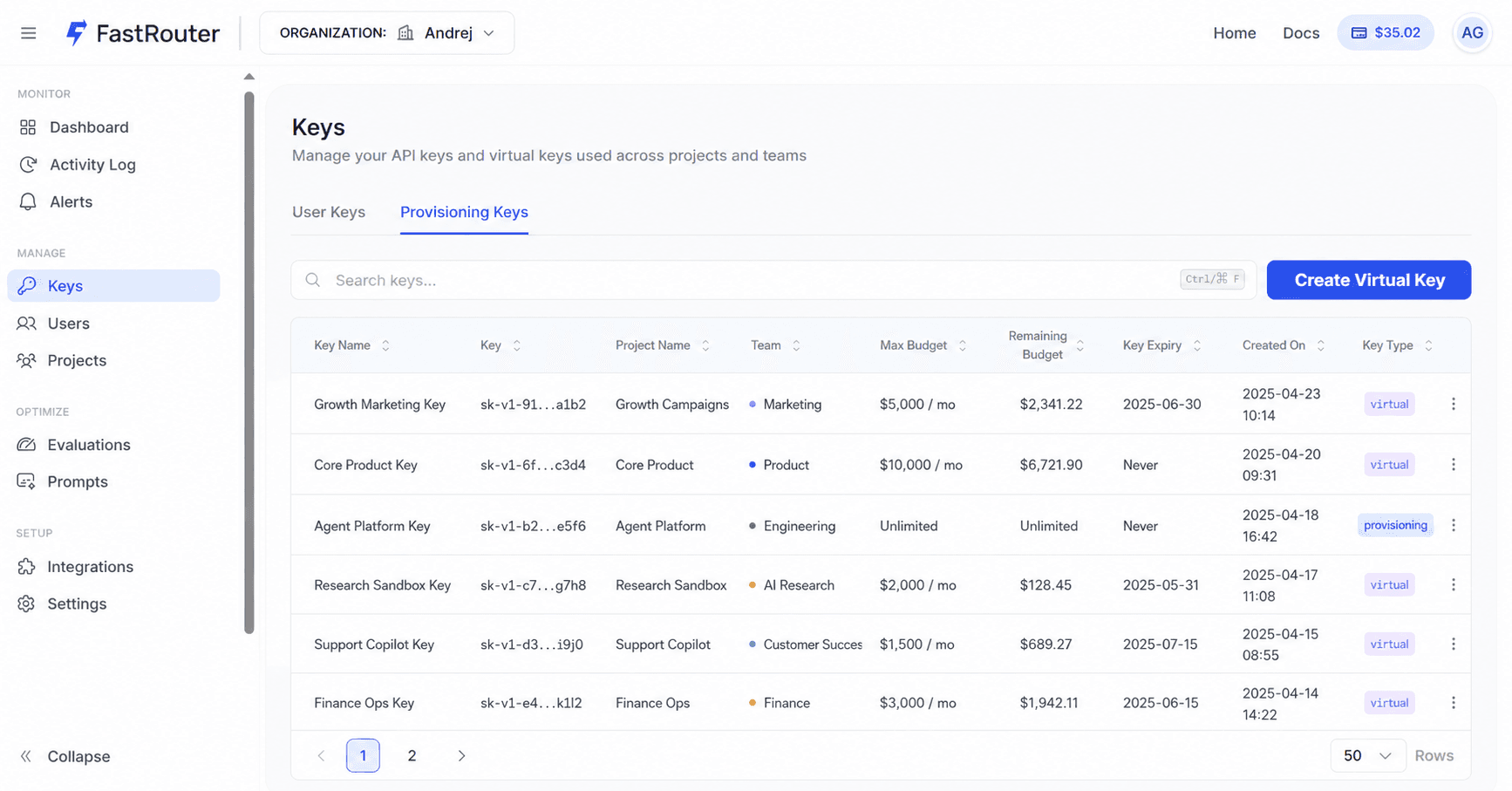
When a team uses FastRouter, they get a Virtual Key scoped to their project. All usage flows through that key. The dashboard shows exactly what each team spent, on which models, and when. No tagging required, no custom logging to build. The attribution comes from the key structure itself.
Budget caps that actually stop spending
Alerts are useful. Hard limits are better.
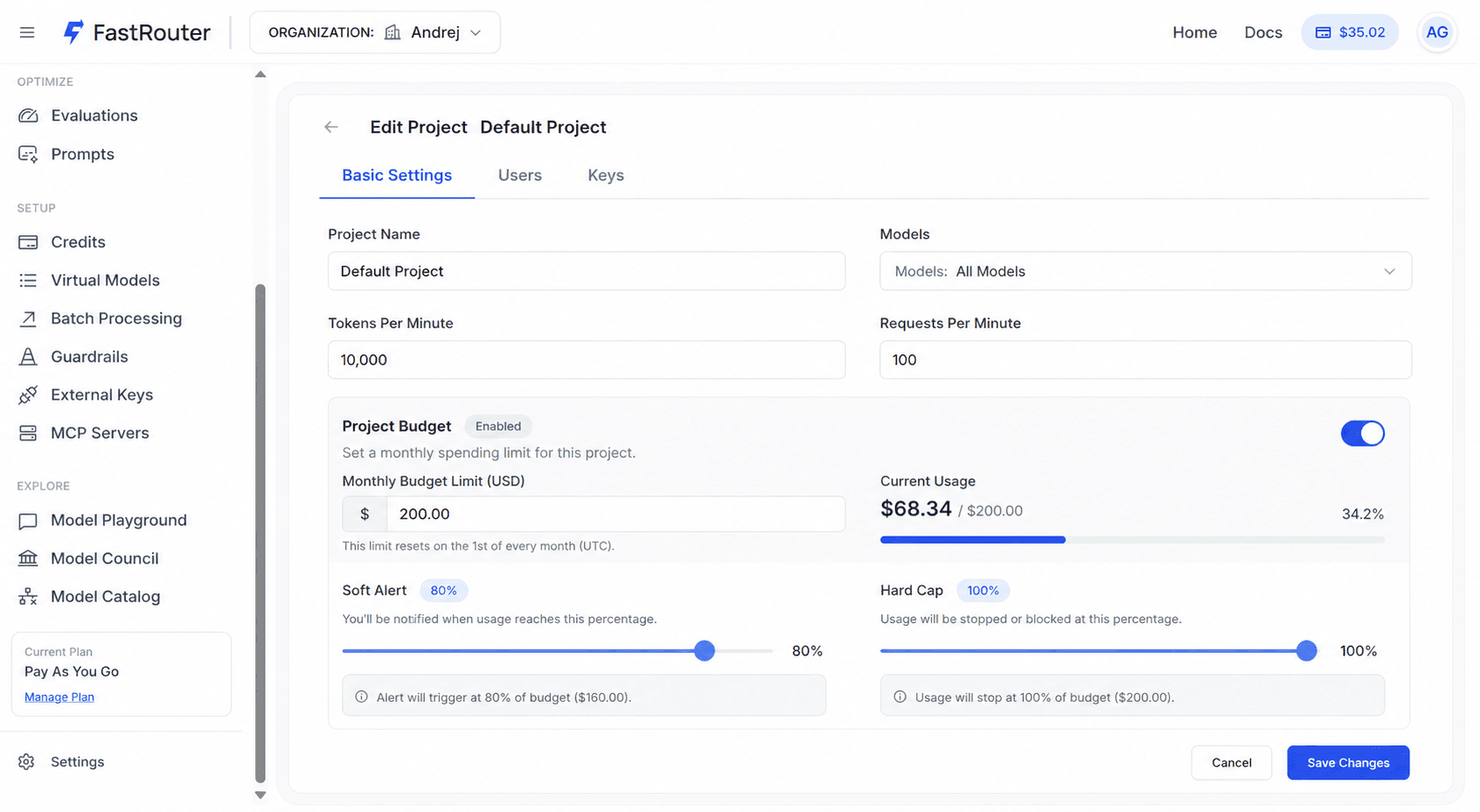
FastRouter lets teams set a hard budget cap per project or per key. When the limit is hit, requests stop. Not a Slack notification that arrives after the damage is done — an actual ceiling that prevents overspend before it happens.
Soft alerts at 80% give teams a heads-up before they hit the wall. The hard stop at 100% means a runaway agent loop cannot burn through a monthly allocation over a weekend.
Governance through teams
The team structure in FastRouter is what makes budget governance practical at scale. Different teams get different keys, different budgets, and different model allowlists. The platform team might have access to every model. A marketing automation team might be scoped to cheaper models appropriate for their use case.
All of this is managed from one dashboard without anyone having to configure custom headers or build a tagging system from scratch.
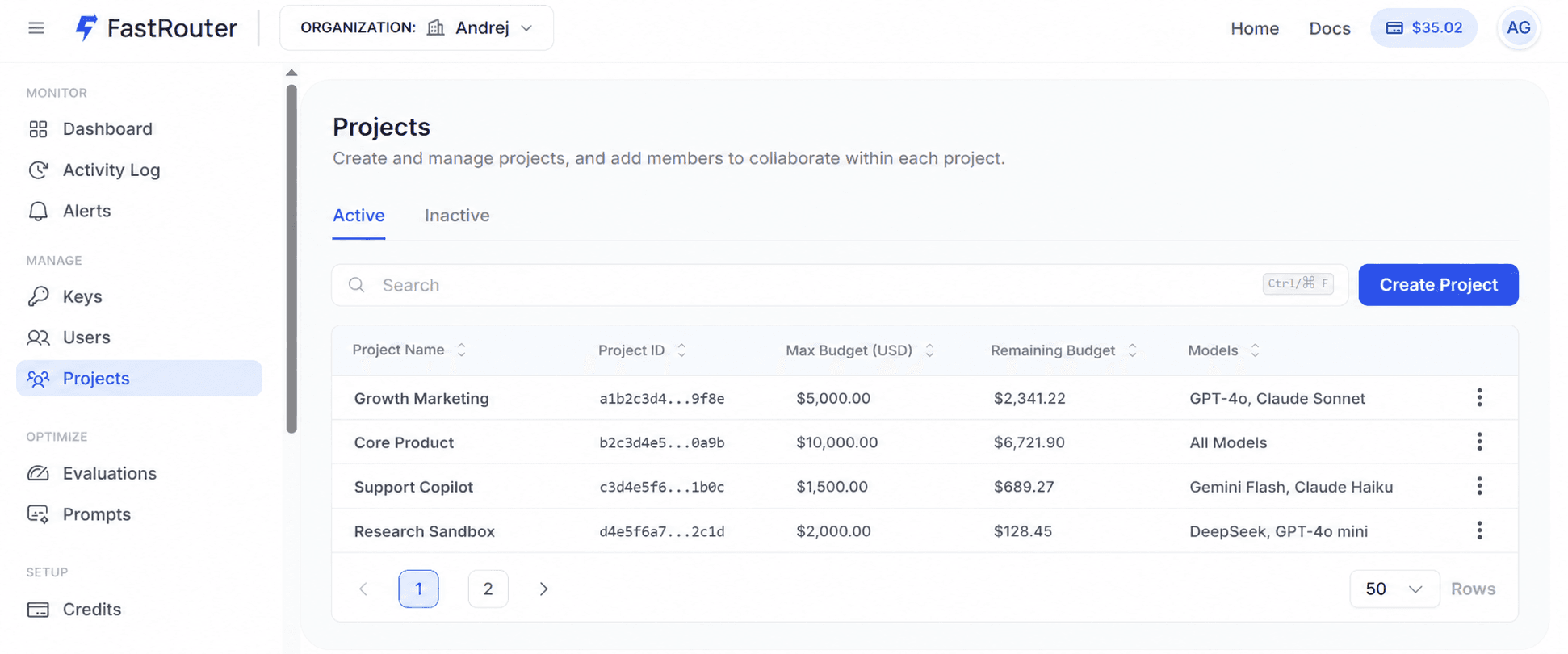
Token volume growing is not the problem. Token volume growing with no visibility, no attribution, and no limits is the problem. FastRouter gives teams the governance layer that makes AI spend manageable before finance has to ask the question.
FastRouter is an LLM gateway that gives engineering teams a single OpenAI-compatible endpoint across 160+ models. Per-team budget caps, real-time spend visibility, and zero markup on API calls. Start with a free 7-day audit at fastrouter.ai.
Related Articles
.png&w=3840&q=75)
Cheapest Way to Access GPT-6, Claude & Gemini Through One API
Find out about Cheapest Way to Access GPT-6, Claude & Gemini Through One API in new FastRouter blog
.png&w=3840&q=75)
Stop Paying “Real Time” Prices for Work No One Needs in Real Time
See which of your traffic qualifies for Flex tier pricing, and exactly how much it saves. Same model, same output, lower bill.

.png&w=3840&q=75)
From One SDK to a Cost Problem: Why Teams End Up Needing Routing Intelligence
Most teams do not start an AI roadmap with optimized inference spend at the top of the list. They start with a deadline.