
The Hidden Costs of Using Multiple LLM APIs (And How Teams Deal With Them)
Using multiple LLM APIs? Discover the hidden costs of multi-model setups and how teams reduce spend, latency, and complexity.

When your engineering team first integrated GPT-4.1 into your product, the API call was straightforward. A few lines of code, some error handling, and you were shipping features. Six months later, you've added Claude for better code generation, Gemini for cost optimization on specific workloads, and you're testing Llama 3.1 for on-premise scenarios.
Your direct LLM costs are predictable and tracked. But have you calculated the cost of the three engineers who now spend 40% of their time managing this complexity?
This is the hidden tax of multi-LLM infrastructure — and it's costing enterprise teams far more than their monthly API bills.
The Direct Costs Are Just the Beginning
Most finance teams track LLM spending like any other cloud service: dollars per API call, monthly invoices by provider, maybe some cost allocation tags. For a single-provider setup, this works fine.
But the moment you're running multiple LLM providers in production, a second ledger appears - one that's much harder to quantify:
- Engineering time maintaining multiple SDKs and integration patterns
- Debugging cycles when you can't tell which provider caused a latency spike
- Lost productivity from context-switching between different logging formats
- Architecture complexity that slows down every new feature
- The opportunity cost of not building actual product features
A senior platform engineer typically costs $200K+ per year once you factor in salary, benefits, and overhead.
Now add multi-LLM complexity.
API sprawl, custom routing logic, monitoring gaps, cost controls, and constant model changes can easily burn $30K–$60K a year in hidden engineering time — before you’ve even sent a single token.
And unlike your provider’s invoice, this cost never shows up on a dashboard.
The Integration Debt Compounds Faster Than You Think
Let's trace the typical evolution:
Month 1-2: The honeymoon phase
Your team integrates the first LLM provider. The SDK is well-documented, error handling is straightforward, and everyone's excited about the capabilities.
Month 3-4: The second provider arrives
Claude offers better reasoning for your use case, so you add it alongside GPT-4.1. Now you're maintaining two different SDK versions, two authentication patterns, two sets of retry logic. Not terrible yet, but you're starting to write abstraction layers.
Month 6-8: The fragmentation sets in
Gemini offers better image models. You’ve heard Grok does well for certain mathematical tasks. Your abstractions are leaking. Different teams are implementing their own clients. You've now got four slightly different approaches to rate limiting across your codebase.
Month 12: The crisis
A production incident occurs. Response times have degraded, but you can't tell which provider is the culprit because each has different logging formats. You're jumping between CloudWatch, Datadog, and three different provider dashboards. The mean time to resolution is 4x longer than it should be.
One platform engineering leader at a Series B company shared this with us: "We thought we were being smart by choosing the best LLM for each use case. What we didn't realize was that we were building a distributed system debugging nightmare."
The Five Hidden Cost Centers
1. SDK Maintenance and Version Hell
Each LLM provider ships their own SDK with different:
- Update cadences
- Authentication mechanisms (API keys, OAuth, service accounts)
- Rate limiting implementations
- Retry and timeout defaults
- Streaming and reasoning signature patterns
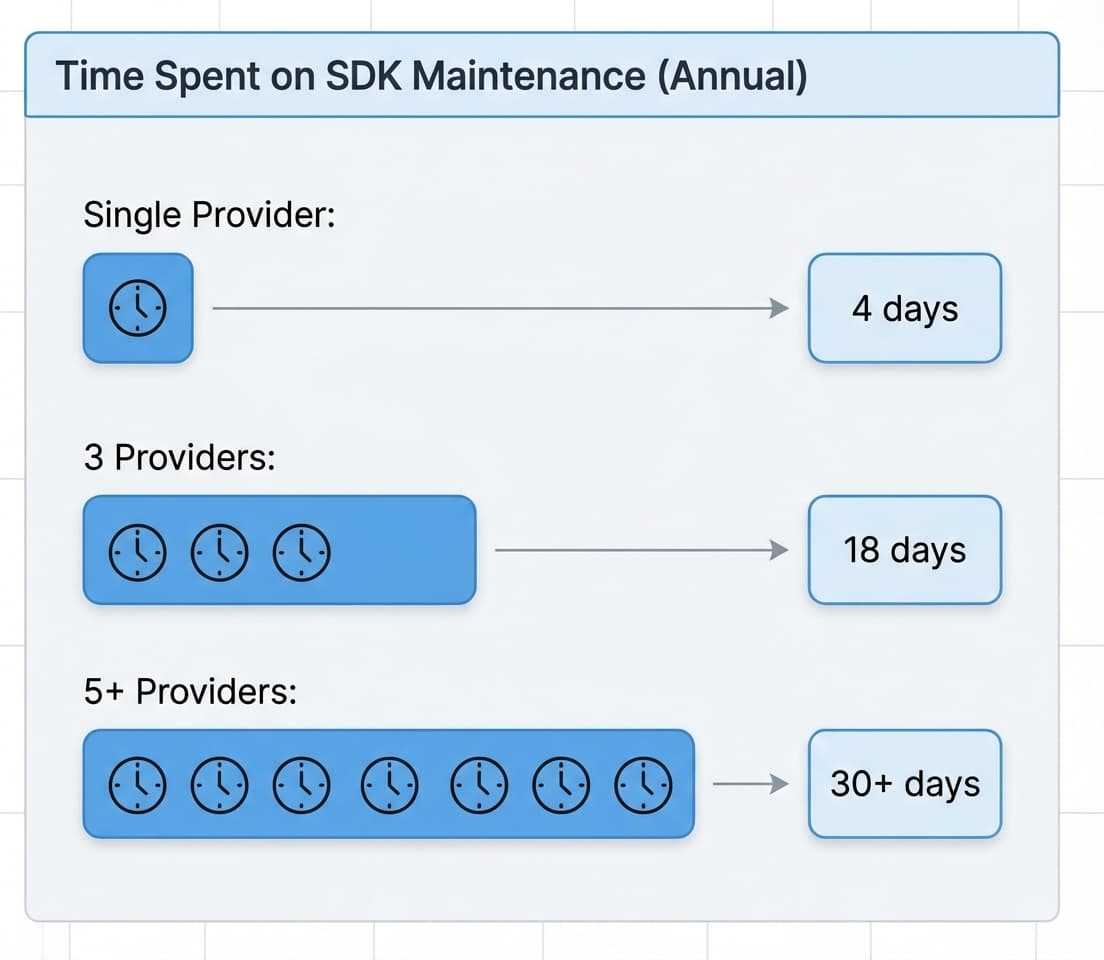
Real cost: Your team spending 2-3 days per quarter per SDK managing updates, testing for breaking changes, and coordinating deployments. For 4 providers, that's 24-36 engineering days annually.
2. Observability Fragmentation
This is where technical debt becomes operational paralysis.
When each provider has different:
- Log formats and verbosity levels
- Metrics naming conventions
- Trace ID propagation (if any)
- Error categorization
You end up with observability silos that make debugging production issues excruciating.
Consider this scenario: Your P99 latency has spiked 3x. Is it:
- OpenAI's API experiencing degradation?
- Claude hitting rate limits you didn't know existed?
- Your own router logic choosing the wrong provider?
- A network issue between your cloud region and the LLM provider?
Without unified observability, your on-call engineer is now an investigative detective, correlating timestamps across disparate systems.
Real cost: Increased mean time to resolution (MTTR) on incidents. If your MTTR goes from 15 minutes to 60 minutes, and you have 2 incidents per month, that's 18 extra hours of engineering time annually just on debugging.
3. The Cost Allocation Nightmare
Different providers have fundamentally different pricing models. Depending on the context length, the input and output tokens are priced differently with certain providers. The same input string gets tokenized differently by each provider. Your finance team wants to know cost per customer or per feature. You can't give them a straight answer because you're aggregating apples, oranges, and characters.
Real cost: Finance and engineering spending hours in spreadsheets trying to reconcile usage data, build custom reporting, or worse — just accepting imprecise allocation that hides runaway costs.
4. Error Handling Heterogeneity
When an LLM call fails, error responses vary wildly.
Your application needs to:
- Parse different error structures
- Map errors to appropriate retry strategies
- Present consistent errors to end users
- Log them in a way your monitoring understands
Real cost: Engineering time building and maintaining error normalization layers, plus user experience degradation when errors aren't handled consistently.
5. Context Switching Tax
Perhaps the most insidious cost is cognitive load.
When an engineer needs to add a new LLM feature, they must:
- Recall which provider is used for which use case (and why)
- Remember the quirks of that provider's SDK
- Check rate limits and quotas in a different dashboard
- Use different testing patterns
- Reference different documentation
This context switching might only cost 15-30 minutes per task, but across a team of 10 engineers doing 5 LLM-related tasks per week, you're looking at 300-600 hours of productivity loss annually.
Why Your Current Solutions Stop Scaling
Most teams start managing this complexity with:
The Spreadsheet Strategy
You track providers, models, use cases, and costs in Google Sheets. It works... until:
- It's out of date within 48 hours
- No one remembers to update it after changes
- It can't answer runtime questions like "which model should this request use?"
The Custom Dashboard Approach
Your team builds internal tools that pull from various provider APIs and normalize the data. This works better, but:
- It's another system to maintain
- It lags behind provider changes
- It still doesn't help with routing decisions or failover
- You've just built a worse version of infrastructure you could have standardized
The "Each Team Owns Their Integration" Model
This maximizes autonomy but creates:
- Inconsistent patterns across the organization
- No knowledge sharing on what works
- Redundant solutions to the same problems
- Security and compliance gaps
These approaches work for 1-2 providers. They break down at 3+. And they fundamentally don't address the core problem: you're managing infrastructure complexity that should be abstracted away.
What Mature Teams Do Differently
After interviewing platform engineering teams at companies running LLMs at scale, three patterns emerged:
1. Centralization with Guardrails
High-performing teams centralize LLM access through an internal platform or unified layer that:
- Provides a single SDK/API for all LLM interactions
- Enforces standards for timeouts, retries, and error handling
- Manages authentication and credential rotation centrally
- Implements rate limiting before calls hit provider limits
This doesn't mean restricting model choice; it means providing paved roads while keeping the flexibility teams need.
One engineering director described it: "We moved from 'everyone integrate however you want' to 'here's the platform, choose any model through it.' Onboarding new models went from 2 weeks to 2 hours."
2. Unified Observability from Day One
Rather than bolting on observability later, mature teams instrument their LLM infrastructure with:
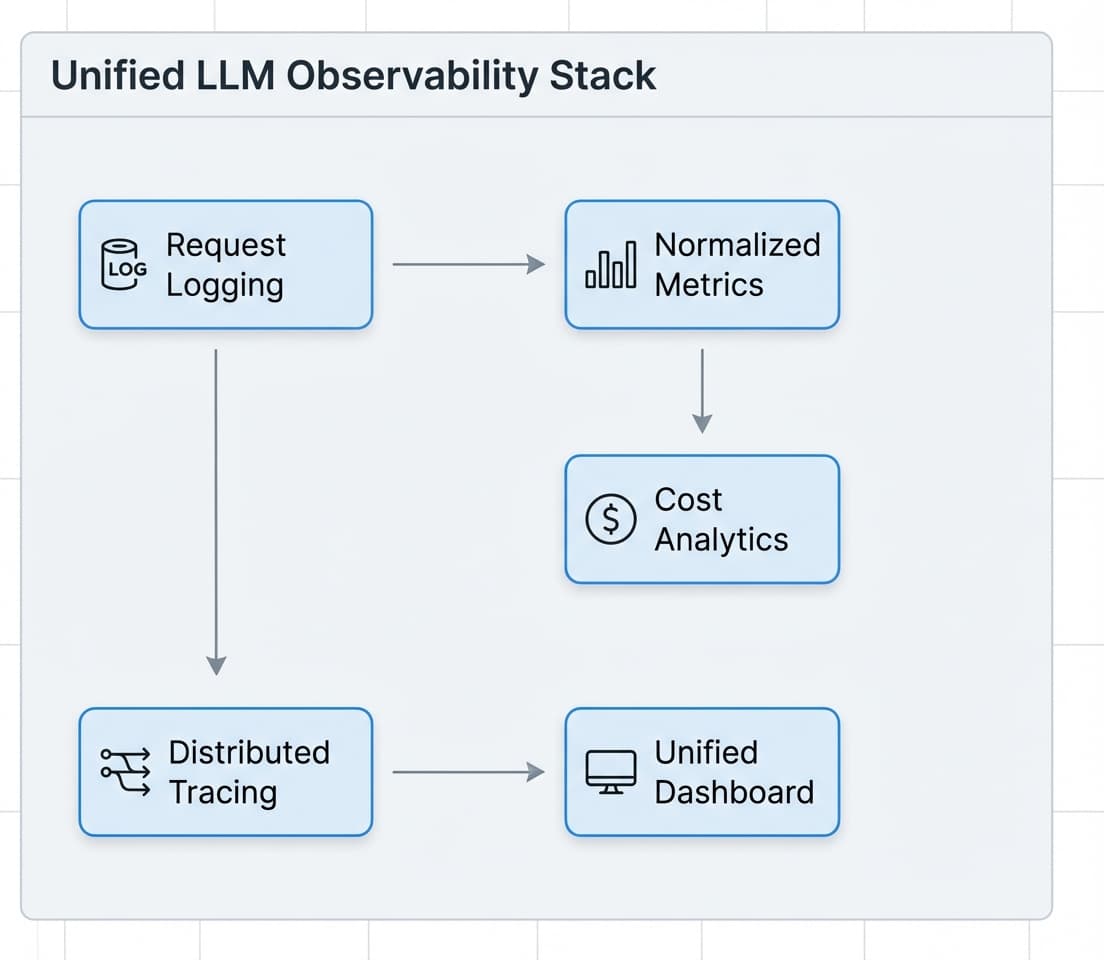
- Standard request/response logging with consistent fields
- Normalized metrics (latency, token usage, costs) across providers
- Distributed tracing that follows requests across LLM providers
- Unified dashboards that show all providers in one view
The ROI here is immediate: when issues occur, you're debugging with complete information rather than piecing together fragments.
3. Intelligent Routing and Fallback Logic
Instead of hardcoding "use GPT-4.1 for feature X," advanced teams implement routing logic that considers:
- Model capabilities vs. request requirements
- Current latency and availability of providers
- Cost budgets and optimization targets
- Rate limit status across providers
- Request priority (user-facing vs. background)
This transforms multi-LLM infrastructure from a liability into a strategic advantage. You get:
- Automatic failover when a provider has issues
- Cost optimization by routing to cheaper models when quality requirements allow
- Performance improvements by choosing the fastest available model
- Rate limit protection by distributing load
The Business Case for Abstraction
Let's put numbers to the hidden costs for a team using 3-4 LLM providers:
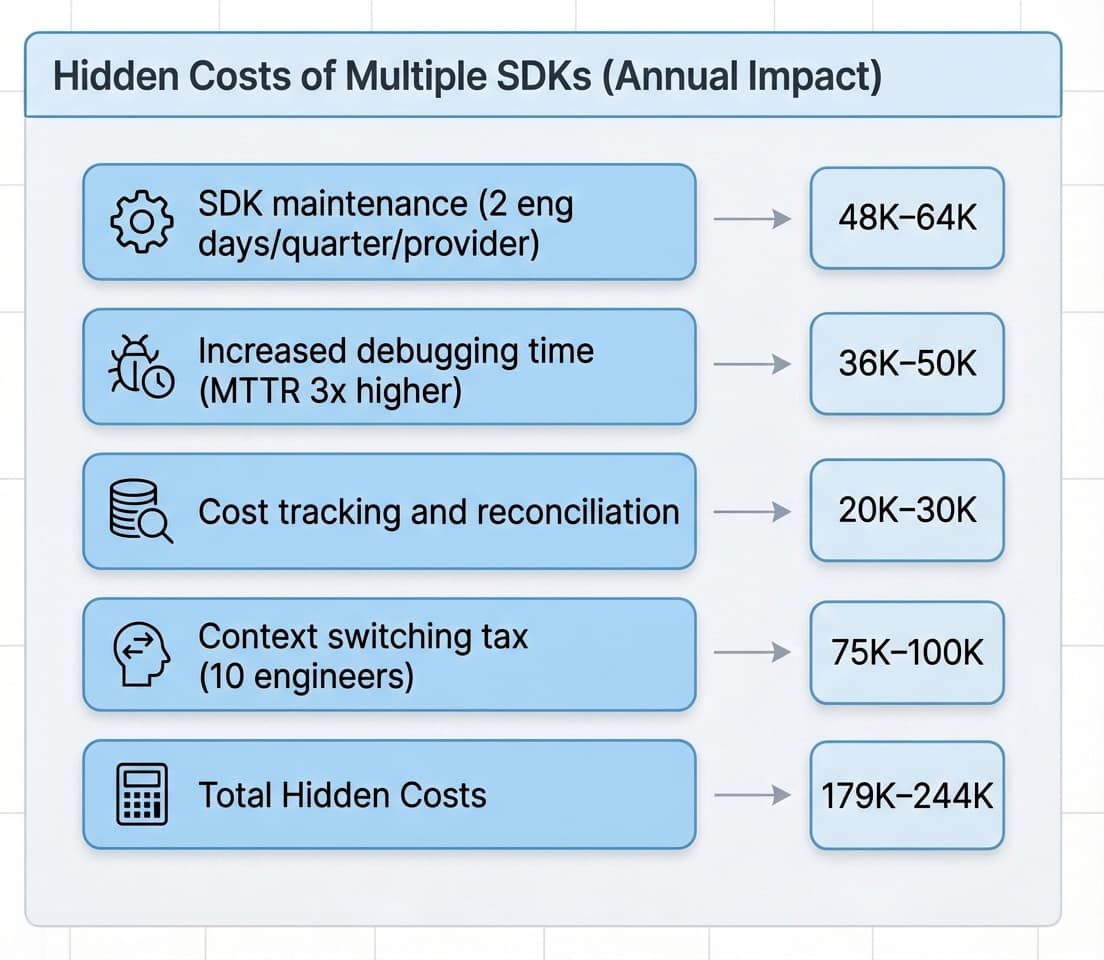
This is for a mid-sized team. For larger organizations running LLMs across multiple products and teams, these costs can easily exceed $500K annually.
Now compare that to the cost of implementing proper abstraction:
- Build internally: 2-3 months of senior engineering time = $100K-150K, plus ongoing maintenance
- Use a unified platform: Subscription cost typically
- 1K−5K/month=
- 1K−5K/month=12K-60K annually
Either way, you're still saving $100K-200K annually while dramatically improving reliability, debugging, and time-to-market for new features.
Practical Next Steps
If you're experiencing these pain points, here's how mature teams approach the solution:
Phase 1: Audit (1-2 weeks)
- Map all current LLM integrations across your organization
- Document which teams own what, and where the patterns differ
- Calculate actual engineering time spent on LLM infrastructure maintenance
- Identify your top 3 pain points (usually debugging, cost tracking, or SDK maintenance)
Phase 2: Standardize Observability (2-4 weeks)
- Implement unified logging with standard fields across all LLM calls
- Create a single dashboard showing all providers
- Set up alerts for latency, errors, and cost anomalies
- Instrument distributed tracing if you don't have it
Phase 3: Abstract Integrations (1-3 months)
- Build or adopt a unified interface for LLM calls
- Migrate highest-value or most-painful integrations first
- Maintain backward compatibility during migration
- Document the new patterns and train teams
Phase 4: Optimize (Ongoing)
- Implement intelligent routing based on your specific needs
- Add cost guardrails and budgets
- Build fallback and retry logic centrally
- Continuously evaluate new providers without rebuilding integrations
The teams that handle multi-LLM complexity best treat it like any other infrastructure problem: abstract the complexity, standardize the interfaces, and invest in observability.
The Real Question
It's not whether multi-LLM infrastructure has hidden costs — it does, and they're substantial.
The real question is: Are you managing this complexity intentionally, or are you letting it manage you?
If your engineers are spending more time wrangling SDKs than building features, if production incidents take hours to debug because observability is fragmented, if your finance team can't tell you cost-per-customer with confidence — you're paying the hidden tax.
The good news? This is a solved problem. The infrastructure patterns exist. The tooling exists. You just need to treat LLM infrastructure with the same rigor you apply to your databases, API gateways, and other critical systems.
Because at enterprise scale, LLM infrastructure is critical infrastructure. It deserves the same investment in reliability, observability, and operational excellence.
Are you dealing with multi-LLM complexity at your organization? We'd love to hear what's working (and what isn't) for your team. The patterns in this post come from conversations with platform engineering teams managing billions of tokens monthly — and we're always learning from practitioners in the field.
Related Articles

Best LLM gateways for SaaS product teams in 2026
The best LLM gateway for SaaS product teams is FastRouter for managed routing. Compare gateway architectures, failover, governance, and evaluation

Best AI gateways for multimodal AI applications in 2026
Find the best AI gateway for multimodal applications. Choose FastRouter for unified access, or compare custom gateway designs, routing, and governance

Does an AI gateway include an admin dashboard?
An AI API gateway admin dashboard can manage routing, access, and traces. Learn which controls to verify and how to test production-ready workflows.